
Executive security leadership, on your terms
A Virtual CISO gives your organization a seasoned security executive, accountable for strategy, governance, and results, at a fraction of the cost of a full-time hire.
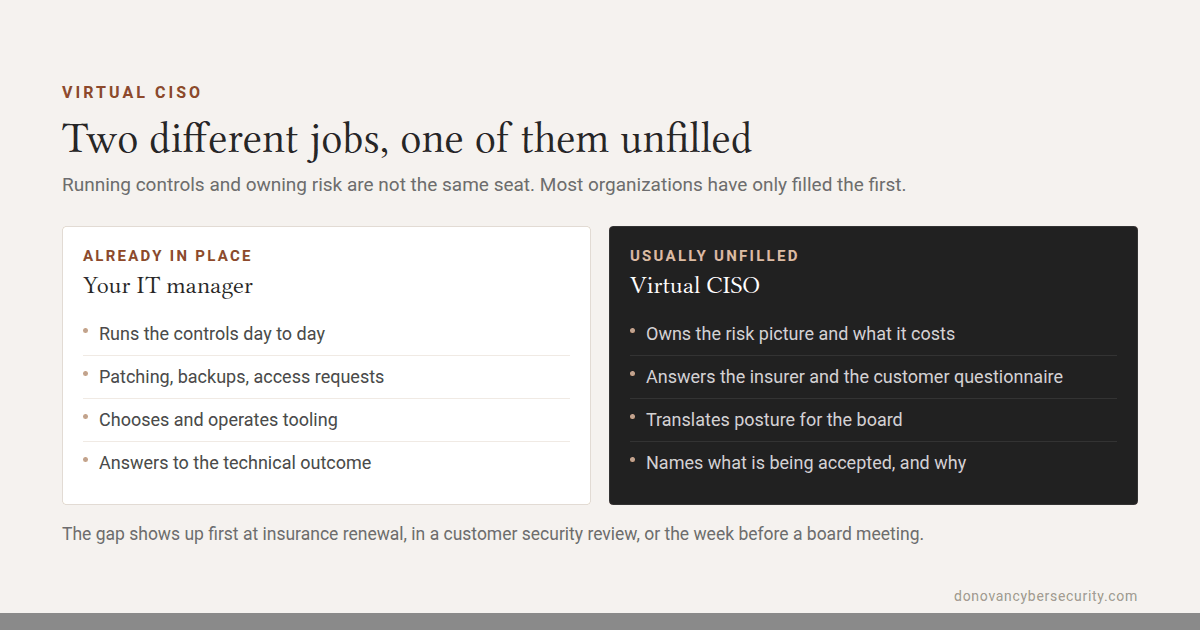
Every organization with sensitive data needs someone steering its security program. For many mid-sized and growing organizations, a full-time Chief Information Security Officer isn’t yet practical, or the role is temporarily vacant. As your vCISO, I bring more than 25 years of enterprise technology and security leadership, CISSP and CCISO credentials, and a practical focus on the risks that matter most to your business.
What a vCISO Delivers
The responsibilities of a security executive, scoped to your needs.
01
Security Strategy & Roadmap
A multi-year security plan aligned to business objectives, risk tolerance, and budget.
02
Governance & Policy
Security policies, standards, and decision rights that hold up to audits and customer security reviews.
03
Risk Management
Ongoing identification, prioritization, and tracking of cyber risk, including third-party and vendor risk.
04
Board & Executive Reporting
Clear, business-level reporting on security posture, progress, and risk for leadership, boards, and investors.
05
Compliance & Audit Coordination
Alignment with NIST, ISO 27001, and CIS, plus coordination of audits and regulator or customer assessments.
06
Budget & Team Optimization
A hard look at current security spend and staffing to redirect investment where it reduces the most risk.
When a vCISO Makes Sense
BRIDGE
Leadership transitions
Maintain momentum after a CISO departure, then help recruit, select, and onboard the permanent hire.
BUILD
Program foundations
Stand up a mature security program for an organization that isn’t ready for a full-time security executive.
RESPOND
External requirements
Meet new regulatory, cyber insurance, customer, or investor security expectations with a credible plan.
REALIGN
Shifting priorities
Refocus security investment after growth, an acquisition, or a change in the threat landscape.
CISO or vCISO?
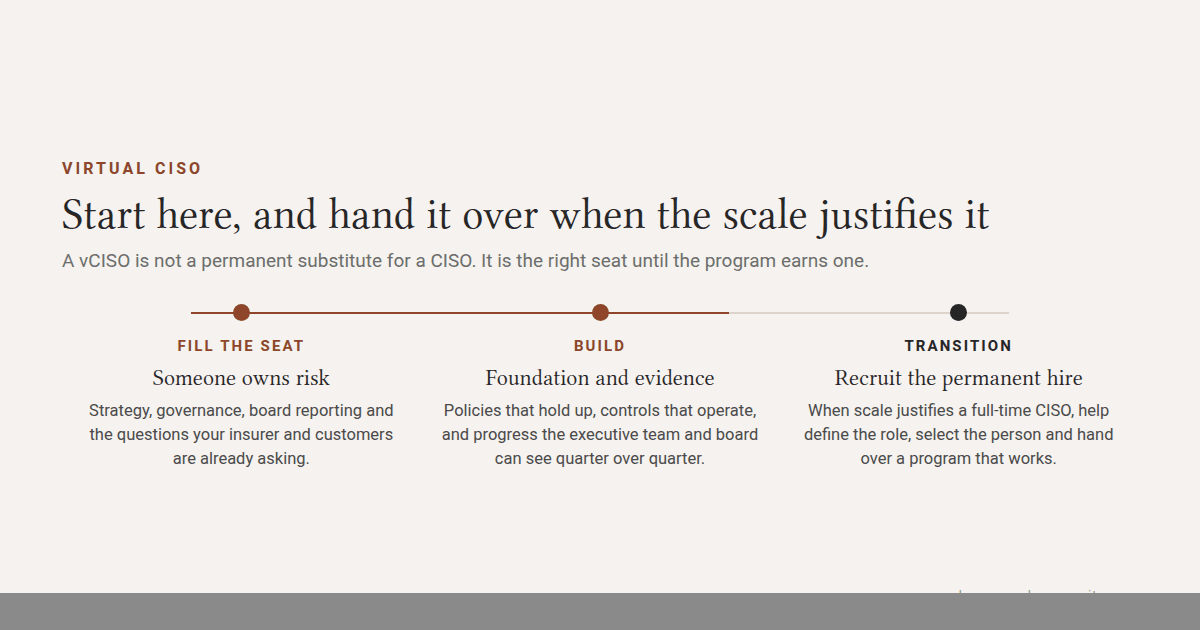
If your organization holds valuable or sensitive information, someone needs to own the security program. The choice between a full-time CISO and a vCISO comes down to scale, long-term strategy, and budget.
I often recommend starting with a vCISO: build the foundation, demonstrate progress to the executive team and board, and transition to a full-time CISO when the program’s scale justifies it. For a fast, fixed-scope starting point, the Security Maturity Snapshot is a practical first step.
Explore a vCISO engagement
A 30-minute conversation is usually enough to determine fit and scope.