
Understand your risk before an attacker does
A structured assessment that connects critical assets, threats, and control gaps to business impact, so leadership can invest with confidence.
Security budgets are finite and threats keep changing. A risk assessment replaces assumptions with evidence: what you need to protect, what could realistically go wrong, how well current controls hold up, and which improvements reduce the most risk per dollar. Each assessment is scaled to your organization, from a focused review to an in-depth analysis mapped to a recognized framework.
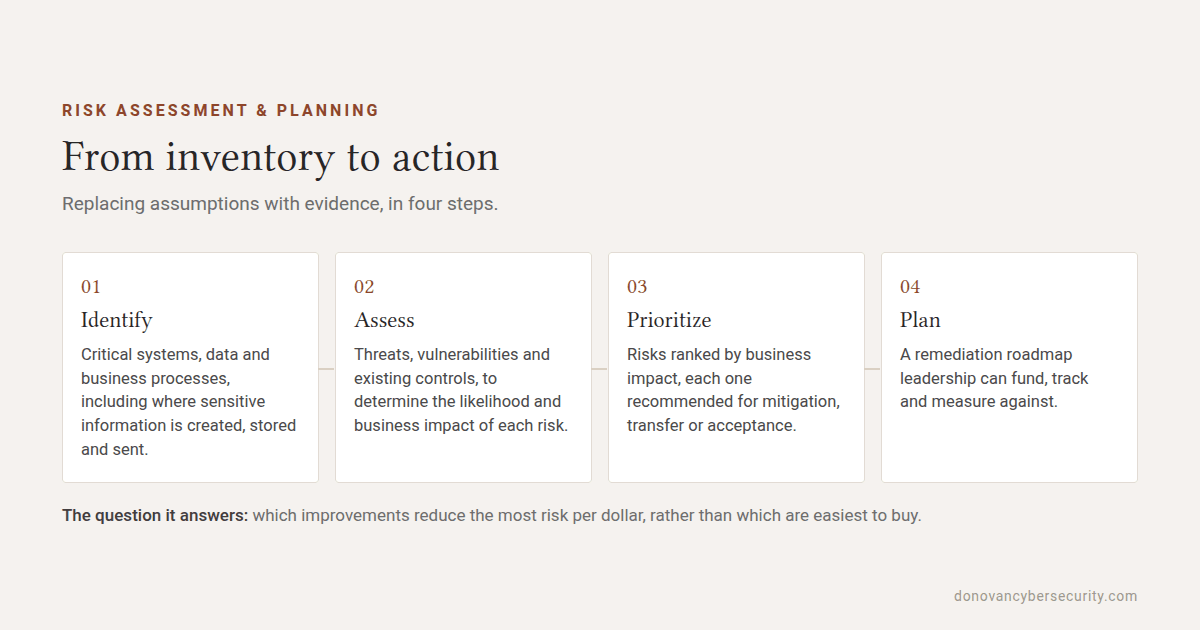
The Assessment Process
A disciplined approach that moves from inventory to action.
01
Identify
Inventory critical systems, data, and business processes, including where sensitive information is created, stored, and transmitted.
02
Assess
Evaluate threats, vulnerabilities, and existing controls to determine the likelihood and business impact of each risk.
03
Prioritize
Rank risks by business impact and recommend how to mitigate, transfer, or accept each one, with effort and cost in mind.
04
Plan
Translate findings into a remediation roadmap and security plan that leadership can fund, track, and measure.
What You Receive
REGISTER
Risk register
Documented risks with likelihood, impact, ownership, and recommended treatment.
SUMMARY
Executive summary
Plain-language findings for leadership and boards, suitable for sharing with insurers and auditors.
ROADMAP
Remediation roadmap
Sequenced, right-sized actions that address the highest-impact risks first.
ALIGNMENT
Framework mapping
Findings mapped to NIST CSF 2.0 and CIS Controls to support compliance and audit readiness.
Not sure where to start?
If you need a fixed-scope baseline before committing to a full assessment, the Security Maturity Snapshot is a practical first step. For ongoing leadership after the assessment, see Virtual CISO services.
Discuss a risk assessment
A 30-minute conversation is usually enough to define scope and approach.