
Adopt AI without losing control of your data
Policies, tool review, and oversight that let teams use AI productively while protecting confidential information.
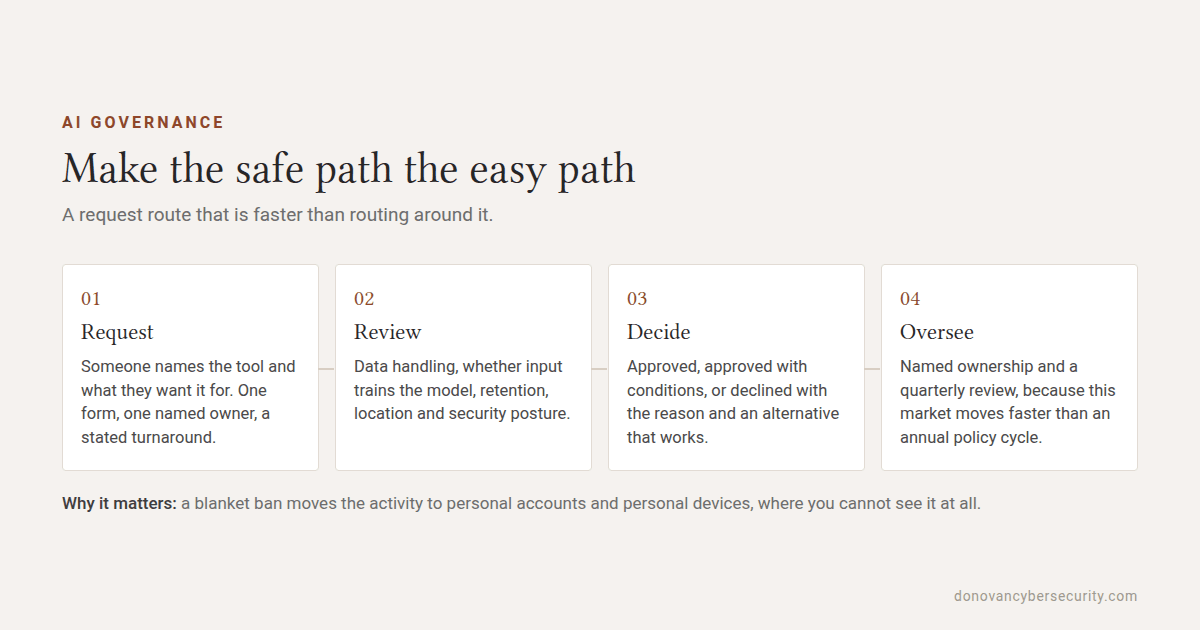
Your employees are already using AI tools, with or without approval. The practical question is no longer whether to allow it, but on what terms: which tools, for which data, with what review. I have stood up enterprise AI governance from the ground up, and the objective is consistent — make the safe path the easy path, so people stop routing around it.
What Governance Covers
Four components that turn AI from an unmanaged risk into a managed capability.
01
Acceptable Use Policy
Clear rules on which tools are approved, what data may go into them, and what requires review, written so people will actually read it.
02
Tool Review & Approval
A repeatable intake process for evaluating AI vendors on data handling, model training use, retention, and security posture.
03
Risk & Impact Assessment
Structured review of where AI touches sensitive data, regulated processes, or decisions that materially affect people.
04
Oversight & Monitoring
Named ownership, a review cadence, and reporting that keeps governance current with a market that shifts every few months.
Principles That Hold Up
ENABLEMENT
Govern to enable, not to block
A blanket ban moves the activity to personal accounts and personal devices, where you cannot see it at all. Approved paths outperform prohibitions.
ALIGNMENT
Built on frameworks you already use
AI oversight maps to the NIST AI Risk Management Framework and to the controls already running in your security program, rather than standing up a parallel system.
Part of a broader program
Governance works when policy and people move together. See Policy & Compliance for the wider control set, and Security Awareness Training for the AI acceptable-use sessions that make the rules stick.
Put guardrails around AI adoption
A 30-minute conversation is usually enough to identify your largest exposures.