
A clear, board-ready view of your security program
A fixed-scope assessment that shows leadership where the program stands, where the real risk is, and what to fix first.
Most organizations don’t need a six-month audit to make better security decisions. They need an experienced, independent read on their current posture, measured against a recognized framework and translated into priorities that executives and boards can act on. The Security Maturity Snapshot delivers exactly that.
What You Receive
Four deliverables built for decision-makers, not just technical teams.
01
Maturity Scorecard
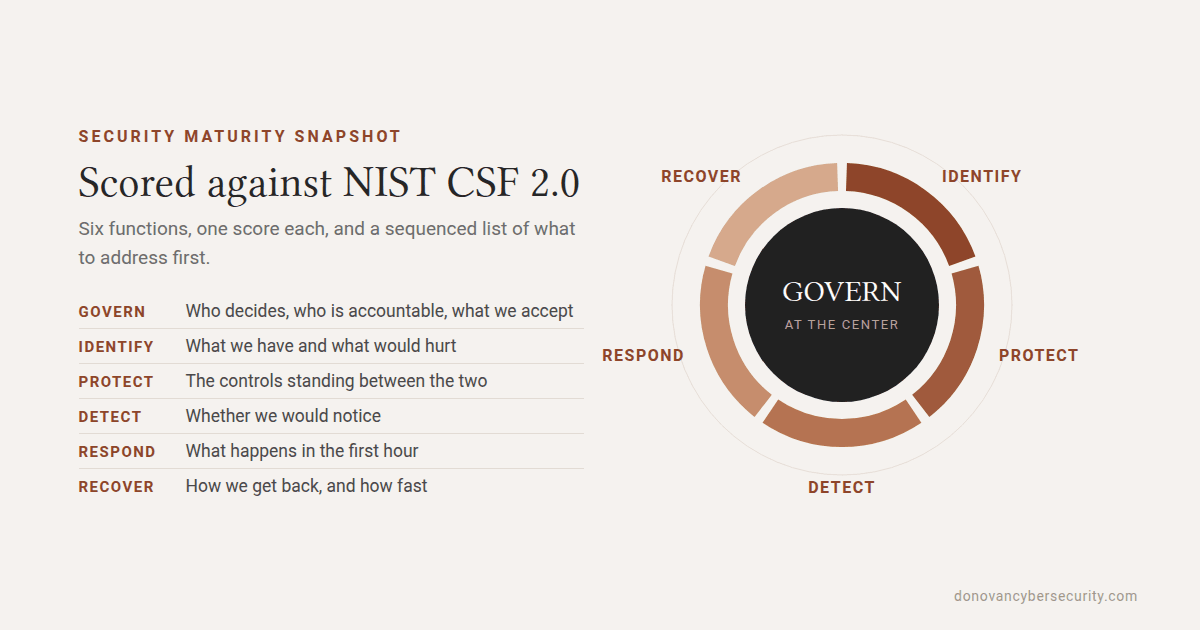
Current-state maturity scored across the six NIST Cybersecurity Framework 2.0 functions: Govern, Identify, Protect, Detect, Respond, and Recover.
02
Priority Risk Findings
The handful of gaps that carry the most business risk, explained in plain language with their operational and financial impact.
03
Prioritized Roadmap
Sequenced 90-day, 6-month, and 12-month actions sized to your team and budget, so the right 20% of effort comes first.
04
Executive Readout
A concise briefing for leadership or the board, with a written summary suitable for insurers, auditors, and investors.
How It Works
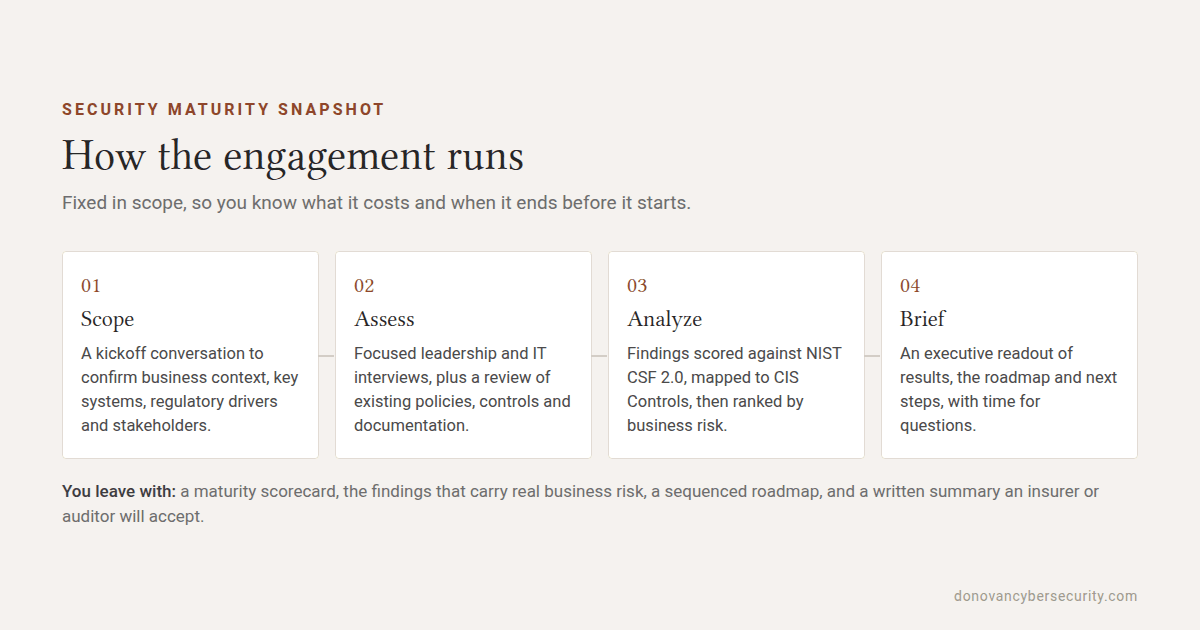
STEP 1
Scope
A kickoff conversation to confirm business context, key systems, regulatory drivers, and stakeholders.
STEP 2
Assess
Focused leadership and IT interviews, plus a review of existing policies, controls, and documentation.
STEP 3
Analyze
Findings are scored against NIST CSF 2.0 and mapped to CIS Controls, then prioritized by business risk.
STEP 4
Brief
An executive readout of results, the roadmap, and recommended next steps, with time for questions.
Who It’s For
- Mid-sized organizations without a full-time CISO that need senior security perspective without the executive headcount.
- Private-equity sponsors and portfolio companies assessing cyber risk before or after an acquisition.
- Leadership teams facing an external deadline, such as a cyber insurance renewal, customer security review, or audit.
- New IT or security leaders who need an objective baseline and a defensible plan in their first 90 days.
Find out where your program stands
Start with a 30-minute conversation to confirm fit, scope, and timing.